Classes
Filter by age group or start date below to register.
Open for Registration
Secure your child's spot in these active sessions.
Personalized Tutoring
Evenings & weekends, In-person (Bountiful) or online
One-on-one help with whatever you bring: extra support with a TaliTech class, general coding, or a project of your own. Pick the rate that matches the student below, then add an hour to your cart.
Note: For students under 11, we recommend a brief consult to ensure readiness for text-based languages.
AI Bootcamp Pt 1: Master AI Tooling for App Building
Build and ship a real app with Python and AI model APIs
You will get to build and ship a real, working app using the exact AI tools professionals use today - Python, AI model APIs, and a real code editor. Managing a real budget, you will learn to weigh cost against quality like an engineer. This is the future of work, taught now. Working the way real engineers do, you will plan a project, call AI models from your own Python code, and iterate until it actually works. You will leave with a finished app you built yourself and a real feel for how modern software gets made.
- Build and ship a real, working app - not just exercises
- Use the exact tools professionals use: Python, AI model APIs, and a real code editor
- Manage a real budget and weigh cost against quality like an engineer
- Small cohort with hands-on coaching; teens and adults learn side by side
Tutoring: Scratch Block-Based Coding
Evenings & weekends, In-person (Bountiful) or online
Block-based coding in Scratch: building games and animations by snapping logic together, and the step up from blocks to writing real code.
Tutoring: Python
Evenings & weekends, In-person (Bountiful) or online
Python from the fundamentals through building something that runs: variables, loops, functions, and projects like a working chatbot.
Tutoring: AP Computer Science
Evenings & weekends, In-person (Bountiful) or online
AP Computer Science topics + high school computer science coursework and homework help.
Tutoring: Building with AI
Evenings & weekends, In-person (Bountiful) or online
Build real projects with AI: AI-assisted coding and vibe coding, context engineering, standing up your own cloud AI agent, and shipping a chatbot or an app with chat inside it. Can also cover setting up AI models that run locally, on a device we provide or on your own device if it meets the hardware requirements.
Tutoring: Minecraft Modding in MCreator
Evenings & weekends, In-person (Bountiful) or online
Minecraft modding with MCreator: custom blocks, items, and mobs, using conditional logic and event triggers to control how they behave.
Tutoring: Computational Thinking
Evenings & weekends, In-person (Bountiful) or online
Focus is core problem solving logic: pattern recognition, step by step sequences, algorithmic thinking, conditional statements (if/else), and loops.
Accepting Inquiries
Dates and times are tentative. Let us know you're interested and we'll contact you with availability.
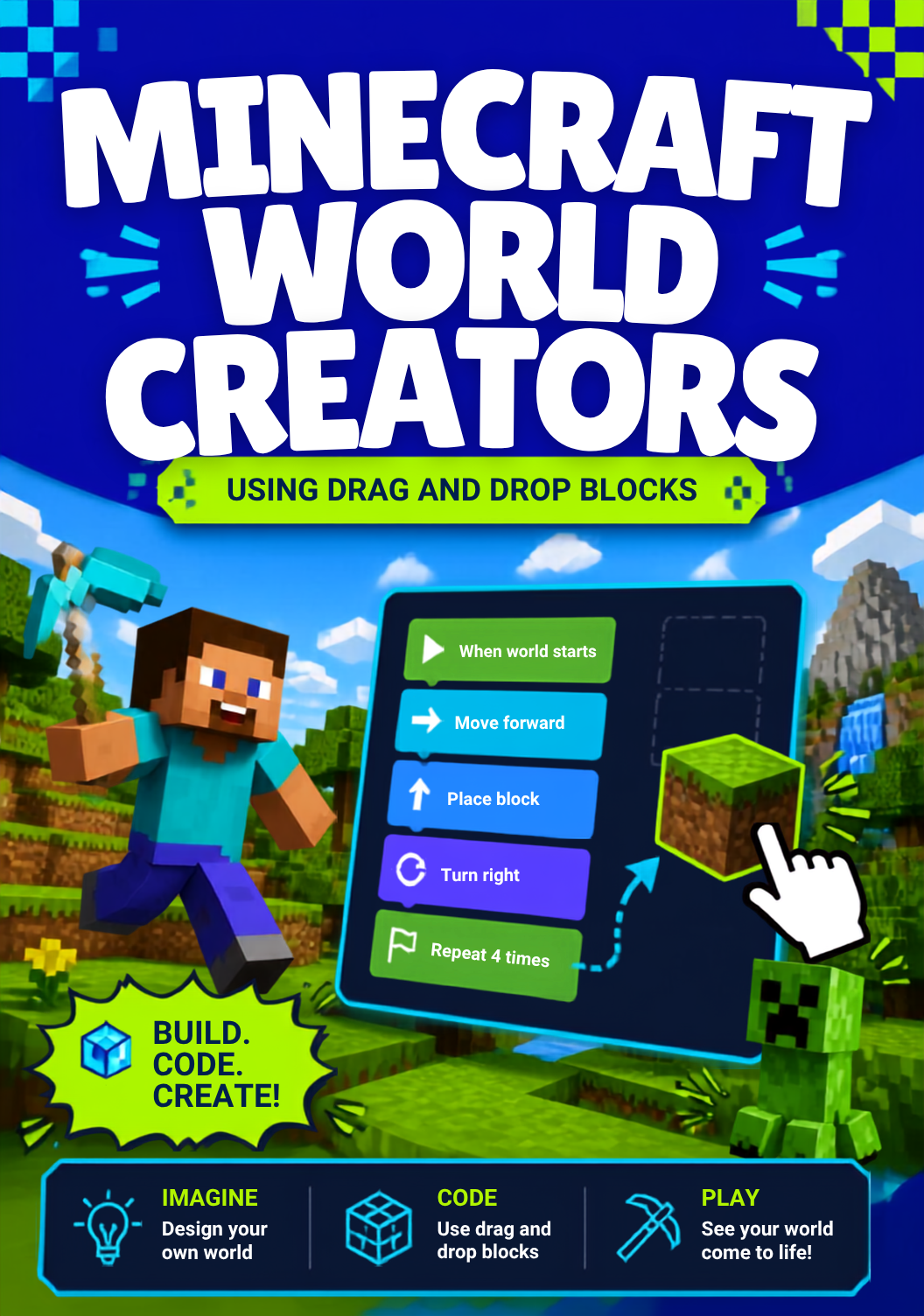
Minecraft World Creators
Design and code your own Minecraft worlds with block coding
Your child steps behind the scenes of the game they love and becomes its designer. Using friendly drag-and-drop block coding, they plan, build, and automate their very own Minecraft worlds, no heavy reading or typing required. Starting from their own drawings and layout plans, students learn to think like builders: sequencing steps, placing structures with logic blocks, and sharing their creations for friendly peer feedback. They leave with a world they designed from scratch and the first real coding habits that every programmer builds on.
- Your child plans a world on paper, then builds it with real logic blocks
- Turns Minecraft play into their first genuine coding sequences
- Practices giving and receiving kind, useful design feedback
- Small class size so every young builder gets hands-on coaching
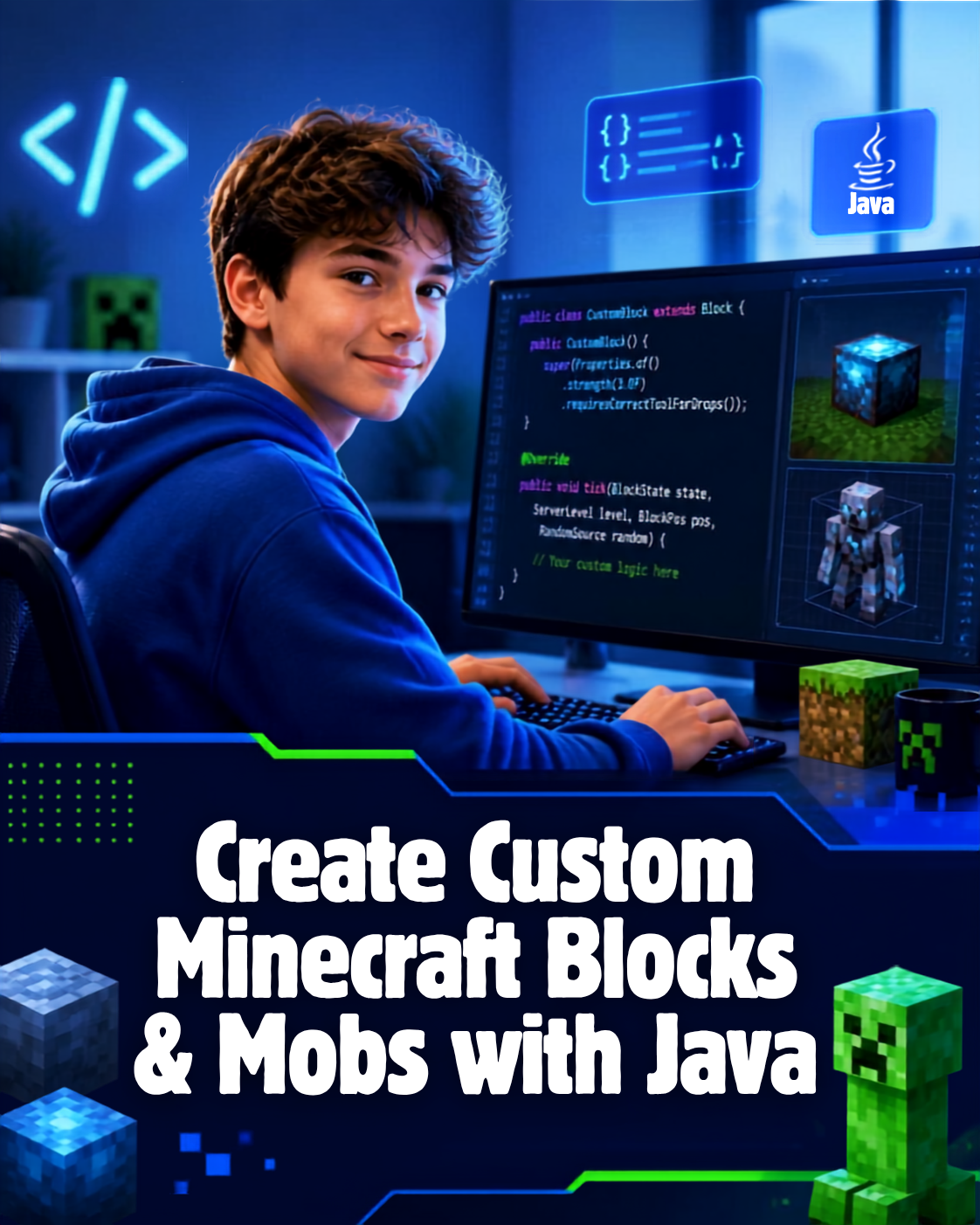
Create Custom Blocks & Mobs with Java
Write real Java to mod Minecraft and learn to code for keeps
Your teen takes a real step into professional software engineering by writing genuine Java, the language behind millions of commercial apps, to mod Minecraft. They move past visual blocks into text-based code inside a professional IDE. Students learn the syntax, classes, and object-oriented ideas that power real software: inheritance, methods, and API integration, all in a context they find genuinely fun. They set up their environment, write custom code to change game mechanics, and debug their own errors, building skills that transfer to any programming language.
- Your teen writes real Java, the language behind millions of professional apps
- Works in a professional IDE, not drag-and-drop blocks
- Learns object-oriented concepts: classes, inheritance, methods, and APIs
- Reads and debugs real compiler errors like an engineer
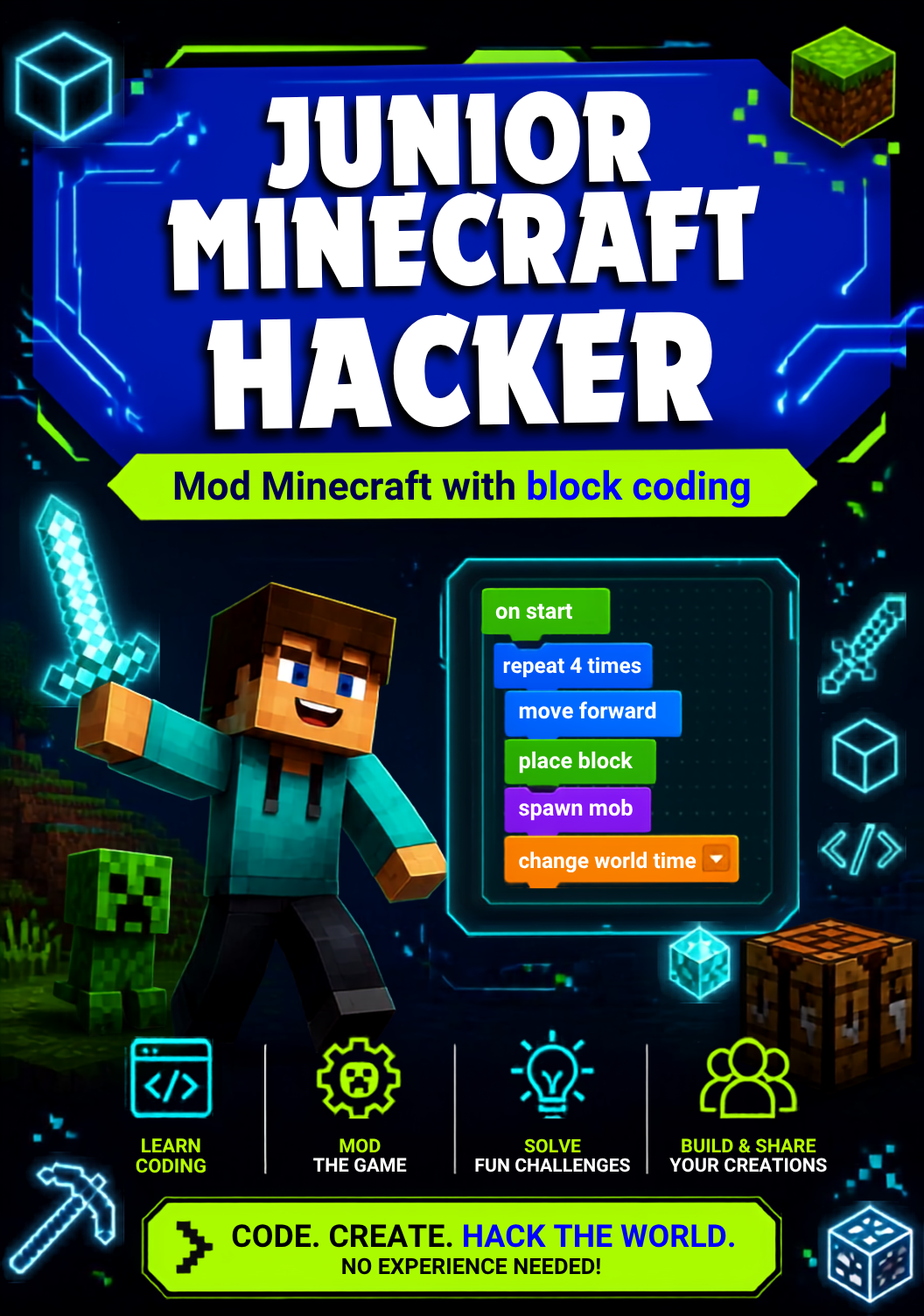
Junior Minecraft Hacker
Build and share your own custom Minecraft mods
Your child goes from playing Minecraft to rewriting its rules. Using visual modding tools, they design, code, and deploy their own custom blocks, items, and creatures, then export a library of mods to share with friends. Along the way students think in systems: defining properties, behaviors, and recipes, and watching how one change ripples through the whole game. They practice real programming logic like conditionals and event triggers, getting their first genuine taste of software engineering inside a world they already love.
- Your child builds and exports real Minecraft mods to keep and share
- Creates custom blocks, items, and mobs with their own properties
- Uses conditional logic and event triggers to control behavior
- Learns systems thinking: how one change affects the whole game
Create & Play Your Own Games: Scratch
Design characters and code your first video game in Scratch
Your child goes from playing games to making them. In Scratch, they design their own characters, draw custom backdrops, and program movement with colorful drag-and-drop code, then play the game they built. Along the way they pick up the real building blocks of programming: sequences, loops, event triggers, and even X-Y coordinates, all wrapped in a story they invented. The class ends with a mini Demo Day where students proudly show their playable game to the class.
- Your child designs and codes a complete, playable game of their own
- Learns core coding ideas: sequences, loops, and event triggers
- Uses real X-Y coordinates to control characters on screen
- Presents their finished game at a celebratory mini Demo Day
Create & Play Your Own Games: Scratch
Build arcade-style games and master game logic in Scratch
Your child becomes the game designer, building classic arcade-style games in Scratch while mastering the computer-science logic underneath them. They manage scores, lives, and game states using variables, and code collisions and physics with conditional logic. Students get real creative freedom, choosing their own themes, characters, and rules, then polish their projects through peer feedback and testing before sharing them online. They finish with a multi-level game they designed and debugged themselves.
- Your child builds a complete arcade-style game with levels and scoring
- Uses variables to track scores, lives, and timing
- Codes collisions and mechanics with conditional logic and broadcasts
- Tests, debugs, and polishes a real project to share
AI Bootcamp Pt 2: Agentic Workflows & Context Engineering
Design and direct autonomous AI agents with Python
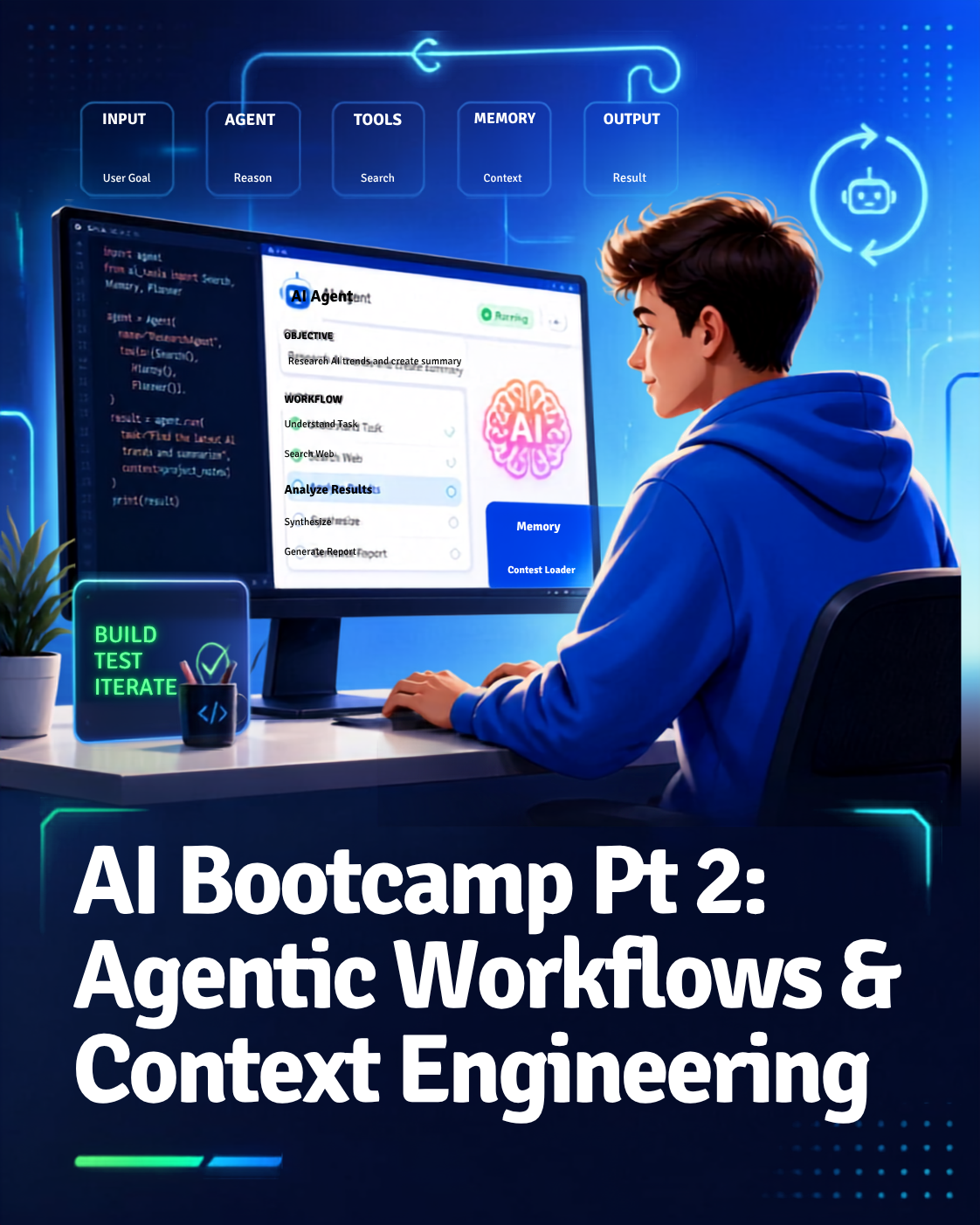
Your teen learns to design and direct autonomous AI agents, the cutting edge of how software is built in 2026. Using Python and a real code editor, they build agent loops and multi-step workflows that run on their own. A standout feature is the API budget mechanic: students manage a capped development budget and make real cost-versus-quality tradeoffs like a working engineer. A dedicated session on security and privacy teaches what data should never be sent to AI models and how to handle API keys safely, the judgment employers say new hires are missing.
- Your teen builds autonomous AI agent loops that run on their own
- Manages a real API budget, weighing cost against quality
- Learns context engineering to get better results from AI models
- Builds real data-privacy and API-key security judgment

AI Explorers: Teach a Computer to See
Intro to computer vision with Google Teachable Machine
What if your child could teach a computer to recognize their drawings, pets, or favorite toys? In AI Explorers, kids train their own image-recognition models using Google Teachable Machine - a friendly, code-free AI tool that lets them see results instantly. Every session follows a hands-on loop: collect images, train a model, test it, and improve it. Along the way, students will learn the limitations of artificial intelligence, including how it's biased by the data you provide it. Students will evaluate different pattern-matching techniques and practice the same train - test - iterate cycle real engineers use.
- Learn how real machine learning models are trained in a beginner-friendly way
- Hands-on learning every session: kids collect, train, test, and improve their ML models
- Small class size for plenty of one-on-one coaching
- Take-home projects kids can share with family and friends

Build Your Own Machine Learning Games
Build and train your first machine learning models to play with in Scratch!
Your child builds a video game that gets smarter the more it plays, powered by a machine learning model they train themselves. They run the full loop real AI engineers use: collect data, train, test, and wire it into a game. It is the difference between using AI and building it. Every session features hands-on projects where kids train models to recognize hand gestures, keypresses, or voice commands, then connect those models directly to games they build in Scratch. Along the way, students learn about dataset size, accuracy, bias, and the engineering mindset.
- Train real machine learning models using images, text, and sounds
- Integrate custom AI models directly into Scratch games
- Learn the entire machine learning pipeline from data collection to testing
- Get personalized guidance with small class sizes